

Celebrating Swinburne’s next generation of researchers
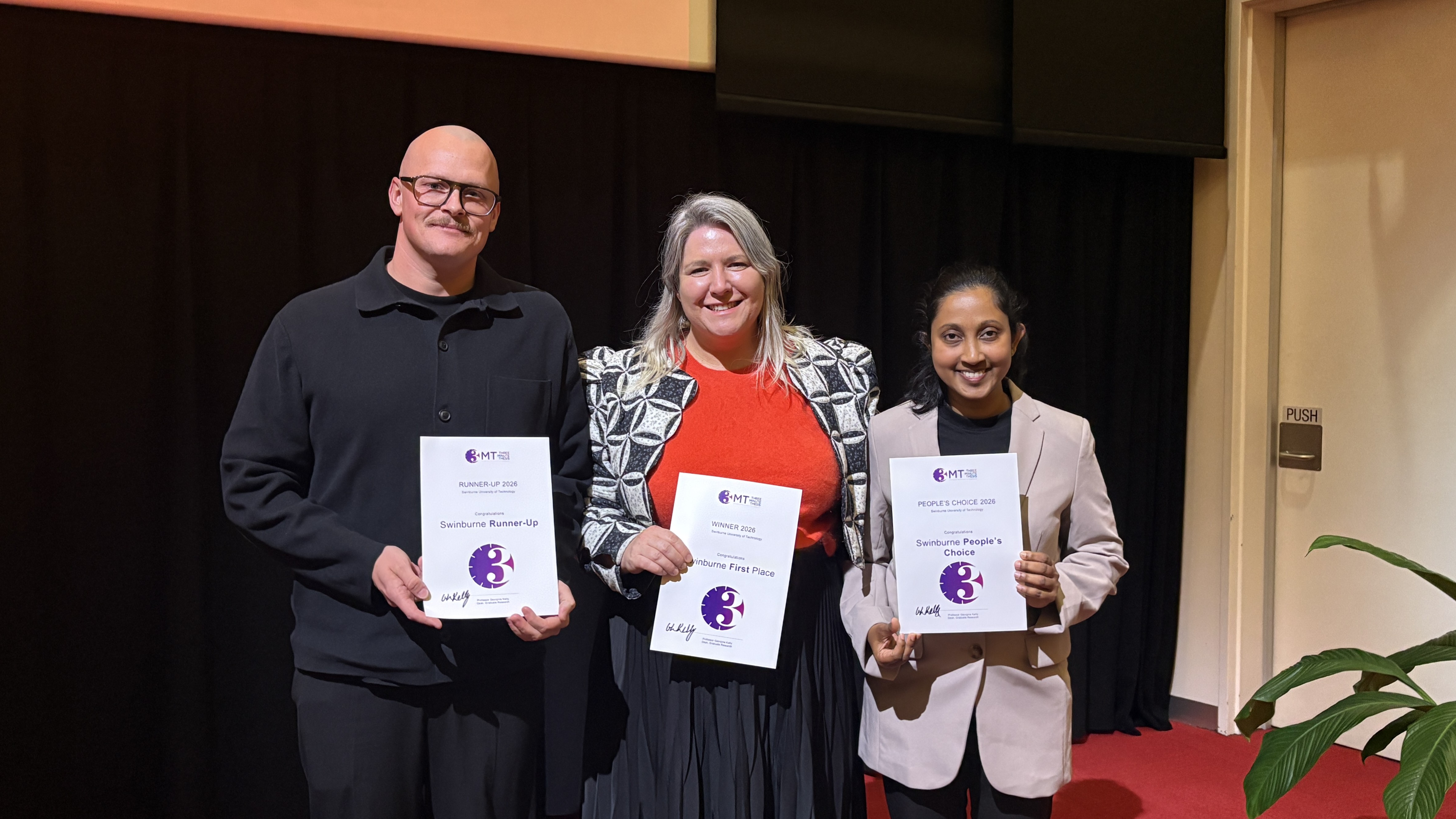
Swinburne's inaugural Research Festival concluded with the Three Minute Thesis and Visualise Your Research competition finals
In summary
Swinburne’s inaugural Research Festival brought together Higher Degree by Research students and Early Career Researchers
Workshops, panels and networking sessions equipped researchers with practical skills to communicate their work and grow their careers
The festival concluded with the Three Minute Thesis and Visualise Your Research finals, with Rowena Ulbrick and Arief Nur Pratomo claiming the top prizes
From big ideas to bite-sized presentations, Swinburne University of Technology’s inaugural Research Festival celebrated emerging researchers shaping the future of research.
Held on 21 July, the festival gave Higher Degree by Research students and Early Career Researchers the chance to build professional skills, connect with peers and take part in practical workshops and panel discussions. The day also included sessions on building an academic brand, research communication and best research practices.
“The Research Festival gave researchers a space to step outside their day-to-day work, learn from one another and amazing guest speakers, and develop the skills that will support their career development,” says Swinburne Dean of Graduate Research, Professor Georgina Kelly.
“More than that, it was also an opportunity to celebrate the remarkable breadth of research taking place across Swinburne,” she says.
Three minutes for big impact
The day concluded with the Three Minute Thesis (3MT) and Visualise Your Research (VYR) finals.
The 3MT competition challenges researchers to explain their research to a general audience in just three minutes, presenting with a single static slide. Designed to strengthen research communication skills, the competition encourages participants to break down complex ideas and demonstrate the real-world impact of their work.
This year's finalists showcased research spanning education, urban design and sustainability.
Rowena Ulbrick was named the 2025 Swinburne 3MT winner for her presentation, ‘Beyond the degree: Embedding capabilities for an uncertain future’. Her research explores how universities can better embed future-ready skills into their curriculum to prepare graduates to navigate a rapidly changing world.
Daniel Ferguson was named runner-up for his presentation, ‘Giving active recreation a sporting chance’. He examined how parks and local infrastructure can be better designed and equipped to support recreational sport participation.
The audience-selected People's Choice Award went to Samurdhie Aryarathne for ‘The missing link: Why firms need a web, not a chain for a future that lasts’, which explores how supply chains can be reimagined to create more resilient and sustainable business networks.
As the competition winner, Rowena will now represent Swinburne at the Asia-Pacific 3MT finals.
-
 Rowena Ulbrick was named the 2025 Swinburne 3MT winner
-
 Daniel Ferguson was named runner-up for Swinburne's 2025 3MT competition
-
 The audience-selected People's Choice Award went to Samurdhie Aryarathne


Bringing research to life
While 3MT challenges researchers to communicate through a spoken presentation, the VYR competition challenges participants to present their research through a compelling 60-second audiovisual piece.
The competition highlights the power of visual storytelling, encouraging researchers to translate complex research into engaging and accessible content for a non-specialist audience. This year, audience members voted to determine both the winner and runner-up.
Arief Nur Pratomo was named the winner for ‘Liquid foam for personalised cushioning’, which explored how to create better fitting and more personalised footwear.
Pasangi Premadasa was awarded runner-up for her research, ‘Electrochemical method for dairy wastewater remediation and hydrogen production’, which investigates how wastewater from dairy production can be transformed into hydrogen in a cost-effective manner.

-
Media Enquiries
Media Enquiries
Related articles
-
Swinburne spinout to cut AI’s energy demands with breakthrough chip
- Technology
A new Swinburne spinout is tackling one of AI’s biggest infrastructure challenges: moving more information through data centres while using less energy.
Friday 30 October 2026 -
50 years of psychology at Swinburne: celebrating the people behind the science
- Education
- Science
- University
Swinburne’s Department of Psychological Sciences celebrates its 50th anniversary in 2026, reflecting on five decades of psychology education, research and professional training.
Wednesday 11 November 2026 -
Swinburne and Siemens expand energy industry training across the Asia-Pacific
- Engineering
Swinburne University of Technology and Siemens are helping the transition to cleaner, safer and more reliable electricity across the Asia-Pacific region through a new practical, localised training initiative.
Tuesday 10 November 2026 -
Powering renewables skills for Australia's energy transition
- Trades
- Sustainability
Swinburne has led the development of innovative training for electricians to build the skills for Australia's energy transition.Friday 06 November 2026 -
Music therapy could help protect cognitive function in people living with dementia

- Science
Swinburne research explores how music therapy could support brain function, memory and cognition in people living with dementia and help delay its onset.Tuesday 10 November 2026


