

Swinburne researchers succeed in latest ARC Discovery Projects

Swinburne University researchers have been awarded more than $6.1 million in funding, across 12 projects.
In summary
Swinburne University researchers have been awarded more than $6.1 million in funding by the 2024 ARC Discovery Projects scheme.
The 12 Swinburne-led Discovery projects span financial abuse, modular buildings, quantum time crystals and quantum polaritons, 3D printing concrete and 4D origami structures, micro-optics, cell attachment to artificial bones and cell signalling, AI tools for software development, and bubble clouds in waves.
The Discovery Projects scheme aims to expand Australia’s knowledge base and research capacity, and deliver economic, commercial, environmental, social and cultural benefits.
Swinburne University of Technology researchers have achieved tremendous success in the latest Australian Research Council (ARC) Discovery Projects scheme, receiving more than $6.1 million in combined funding for 12 Swinburne-led projects.
Commencing in 2024, the 12 projects span a wide range of research topics. They will deliver research excellence in areas including financial abuse, modular buildings, quantum time crystals and quantum polaritons, 3D printing concrete and 4D origami structures, micro-optics, cell attachment to artificial bones and cell signalling, AI tools for software development, and bubble clouds in waves.
Swinburne’s success rate in this year’s Discovery Projects scheme was 30 per cent, a significantly higher rate compared to the national success rate of 16 per cent.
Swinburne’s Professor Karen Hapgood, Deputy Vice-Chancellor Research, said the latest ARC funding success is a testament to the impactful work underway by our researchers.
“This is an outstanding result for our research community. These projects reflect the world-leading research being done across Swinburne to help drive change that will positively impact society,” Professor Hapgood said.
“I congratulate everyone involved and look forward to the successful outcomes from these 12 exciting projects.”
ARC Discovery Projects
The Swinburne researchers leading ARC Discovery Projects in 2024 are:
Professor Peter Kingshott and Professor Elena Ivanova ($565,000) for the project Nanoengineered hybrid coatings that control inflammation to artificial bone.
Professor James Ogloff, Dr Benjamin Spivak, Professor Marilyn McMahon and Professor Michael Daffern ($680,000) for the project Examining the impact of remand and the utility of bail risk assessments.
Professor Guoxing Lu and Dr Jianjun Zhang ($387,000) for the project 4D printed origami structures: Deformation mechanisms and mechanics.
Professor Saulius Juodkazis, Professor Jonathan Lawrence and Associate Professor Vijayakumar Anand ($528,000) for the project 3D integrated crystalline UV optical lens-fiber couplers for astronomy.
Professor Xiaodong Huang, Associate Professor Shiwei Zhou and Dr Sayanthan Ramakrishnan ($520,000) for the project Optimisation of buildable structures for 3D concrete printing.
Professor Yang Xiang, Associate Professor Sheng Wen and Dr Xiaogang Zhu ($497,000) for the project Attribution of machine-generated code for accountability.
Professor Sarah Russell, Dr Mirren Charnley, Professor Federico Frascoli, Professor Damien Hicks and Professor Patrick Humbert ($664,000) for the project Mapping the integration of T cell fate control across time and space.
Professor Peter Hannaford, Professor Krzysztof Sacha, Professor Andrei Sidorov and Associate Professor Hui Hu ($534,000) for the project Big time crystals: a new paradigm in condensed matter.
Professor Emad Gad, Associate Professor Javad Hashemi, Professor Olivia Mirza, Professor George Clifton and Professor James Lim ($366,000) for the project Robustness-orientated and serviceable design of innovative modular buildings.
Professor Kay Cook, Dr Rachael Burgin and Dr Georgina Dimopoulos ($380,000) for the project Developing systemic interventions for intimate partner financial abuse.
Professor Richard Manasseh and Professor Andrew Ooi ($541,000) for the project Bubble clouds in ocean waves.
Professor Xia-Ji Liu and Dr Han Pu ($457,000) for the project Making strong interacting photons.
The Discovery Projects scheme aims to expand Australia’s knowledge base and research capacity, and deliver economic, commercial, environmental, social and/or cultural benefits for Australia.
-
Media Enquiries
Media Enquiries
Related articles
-
Swinburne recognised as a national leader in research and innovation
- Technology
- Education
- Science
- University
Swinburne has been named as Australia’s leading institution in two research fields, with five researchers recognised among the nation’s best in The Australian Research Magazine 2027.
Tuesday 24 November 2026 -
Research commercialisation is a team sport, not a solo sprint

- Technology
- Education
- Science
- University
Swinburne’s Deputy Vice-Chancellor, Research, Karen Hapgood and Werner van de Merwe, Vice President, Innovation and Enterprise explores how Swinburne turns research and innovation into meaningful industry impact.
Tuesday 24 November 2026 -
Music therapy could help protect cognitive function in people living with dementia
- Science
Swinburne research explores how music therapy could support brain function, memory and cognition in people living with dementia and help delay its onset.Tuesday 10 November 2026 -
Swinburne secures funding to strengthen Australia's future energy networks

Swinburne has secured $2.2 million in funding as a leading university partner for a project to develop next-generation quantum timing technology for Australia's energy networks.
Friday 23 October 2026 -
Four new projects announced at the 2026 FACET Symposium in Sydney
- Science
- University
- Sustainability
- Engineering
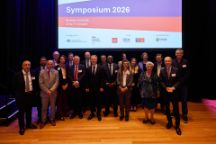
The 2026 Franco-Australian Indo-Pacific Centre for Energy Transition (FACET) Symposium held in Sydney brought together experts, researchers and industry leaders for an event that discussed building resilient infrastructure, next generation power systems and integrated energy solutions.
Tuesday 27 October 2026


