

Reducing carbon emissions in astronomy
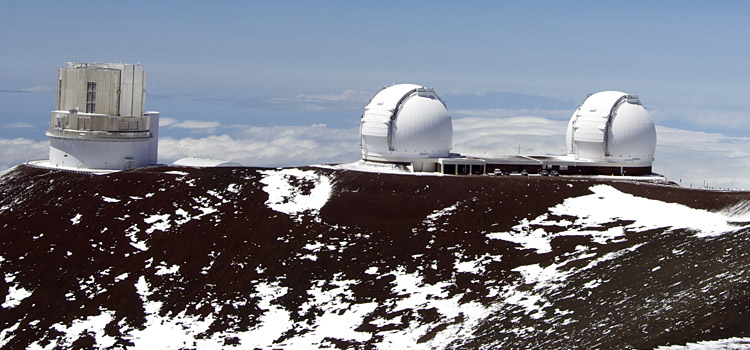
Swinburne's access to the W M Keck Observatory, atop Mauna Kea in Hawai’i, was detailed in a study assessing carbon emissions in astronomy. The mountain is adjacent to Mauna Loa, the premier site in the world for measuring atmospheric carbon dioxide levels. Credit: Dr Adrian Malec.
In summary
- A new study sheds light on carbon emissions produced by the Australian astronomical community
- The study makes recommendations for reducing the impact of conducting research on our planet
- Since the study was conducted, Swinburne has reduced its overall carbon emissions by 70 per cent
Many aspects of being an astronomer result in the emission of greenhouse gases that contribute to climate change. These include direct emissions from flights, and indirect emissions from the electricity required to power supercomputers, observatories and other facilities.
A study published in Nature Astronomy sheds light on carbon emissions produced by the Australian astronomical community and makes recommendations for how astronomy and other industries can carry out cutting-edge research with a reduced impact on our planet.
The new study, led by Swinburne alumni Dr Adam Stevens and Dr Sabine Bellstedt, and including Professor Michael Murphy from the Centre for Astrophysics and Supercomputing (CAS), found that the work-based emissions of the average Australian astronomer are equivalent to around 37 tonnes of carbon dioxide per year.
On a per-capita basis, this is 40 per cent higher than the average Australian adult and five times the global average.
Carbon emissions at the Centre for Astrophysics and Supercomputing
The study found that the use of Swinburne’s OzSTAR supercomputer – used for astrophysical simulations and processing astronomical data – was by far CAS’s largest carbon emissions source, followed by air travel, then emissions from electricity use in on-campus workplaces.
Another important factor, but one that is difficult to estimate, Professor Murphy says, is the carbon emissions from CAS’s use of world-wide astronomical observatories.

“We are very fortunate to have access to the W M Keck Observatory in Hawai’i through a collaborative agreement with Caltech in the USA, but of course we then share in the carbon emissions for operating these amazing telescopes. However, our audit found this is a relatively small part of CAS’s carbon budget at present.
"We are also travelling to Hawai’i less often after installing the world's most remote observing facility on our Hawthorn campus."
Reducing emissions at Swinburne
Since the study was conducted, Swinburne has signed a contract with Infigen Energy to procure 100 per cent renewable electricity from July 2020. This will drastically reduce Swinburne’s carbon footprint as emissions from our electricity represent more than 70 per cent of our total emissions.
This includes the OzSTAR supercomputer as well as carbon emissions from office electricity use.

At the time of the study, the OzSTAR supercomputer was being powered by electricity from Victoria's brown-coal-dominated grid. It is now powered by 100 per cent renewable electricity.
“Members of CAS were strong proponents of the move to 100 per cent renewable electricity in Swinburne, primarily because our supercomputing needs have such large electricity requirements,” Professor Murphy says. “This single action has likely reduced CAS's carbon emissions by more than 80 per cent, based on pre-COVID–19 figures.”
Reducing air travel emissions will be more difficult. Professor Murphy says that a positive outcome from the current pandemic may be the long-term reduction of air travel for conferences and meetings as the quality and experience of virtual conferences improves.
He adds that every profession has a responsibility to understand and reduce its carbon footprint, and astronomy is no exception.
“We've now completed an initial audit of Australia's astronomy carbon emissions, so we know very well how to reduce them. We just need to get on with it and many astronomy institutes around the country are well on their way."
-
Media Enquiries
Related articles
-
- University
Swinburne recognises Australian space innovator with Honorary Doctorate
Swinburne University of Technology has recognised Katherine Bennell-Pegg, a trailblazer in space engineering and exploration, with an Honorary Doctorate of the University.
Friday 08 May 2026 -
- Astronomy
- Science
- University
Swinburne astrophysicist makes Forbes 30 under 30 Asia list
Swinburne astrophysicist and science communicator Dr Kirsten Banks has made the Forbes 30 under 30 Asia list for social media, marketing and advertising
Friday 29 May 2026 -
- Astronomy
One of the world’s most ambitious 3D immersive LED screens, the Virtual Universe, launches at Swinburne
Swinburne's Virtual Universe is opening at Swinburne University of Technology for public and undergraduate education
Thursday 30 April 2026 -
- University
Swinburne recognises space innovator with Honorary Doctorate
Swinburne University of Technology has recognised Anousheh Ansari, a trailblazer in space engineering and exploration, with an Honorary Doctorate in Science.
Friday 17 April 2026 -
- Student News
- Technology
- Science
- University
Swinburne awards 2025 University Medals to outstanding students
From cutting‑edge science and technology to world‑leading research, three Swinburne students from the School of Science, Computing and Emerging Technologies have been recognised with the prestigious 2025 University Medal
Thursday 16 April 2026


